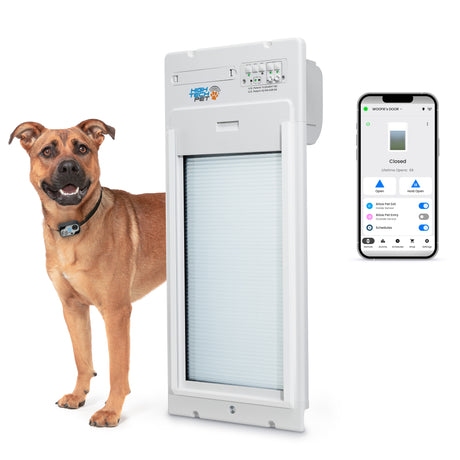


If you've ever left a standard flap-style pet door unlocked overnight, you already know the problem: it doesn't just let your dog in. It lets in whatever else wanders up to it — raccoons hunting for food, opossums, stray cats, even the neighbor's dog. An electronic dog door like Power Pet solves this problem with ultrasonic technology, and once you understand how it works, it's hard to imagine going back to a plain flap. It's a surprisingly simple concept once you see it in action — no cameras, no motion-triggered guesswork, just a door that only responds to a signal from an ultrasonic collar the pet wears, and you're always in total control with the app. That simplicity is part of why it's become one of the more popular upgrades among owners dealing with recurring wildlife problems, rather than a niche or overly complicated fix.
What "ultrasonic" actually means here
Your dog wears a small transmitter collar that emits an ultrasonic signal — a frequency humans can't hear. The door's receiver is tuned to recognize that specific signal at close range. When your dog approaches wearing the collar, the door unlocks and opens for a few seconds, then closes and relocks automatically. No collar signal, no entry — it's that simple.
Why this keeps wildlife and strays out
Raccoons are notorious for figuring out how to flip, pry, or push through unlocked pet doors, and they don't stop at raiding food from the counter. An ultrasonic-locked door removes the guesswork: there's no mechanical latch to defeat and no flap to muscle open, because the door simply doesn't unlock without the matching collar signal nearby. The same logic applies to burglars, neighborhood cats, and other dogs that might otherwise treat an unlocked flap as an open invitation.
It still gives your dog full freedom
Most security systems sacrifice convenience for safety, but there's no tradeoff with Power Pet. Your dog isn't waiting on you to let them in and out — the door responds to the collar the moment they're within range, so daily routines like backyard access, potty breaks, and supervised outdoor time stay exactly as easy as they were with an open flap. You get the security of a locked entrance without adding a single extra step for your dog.
What to check before you buy
Range and battery life on the transmitter collar are the two specs worth comparing across models — you want a collar that holds a charge through a normal day and a receiver range that matches your yard layout.
Does it work for cats too?
Ultrasonic systems are collar-based, so the underlying mechanism doesn't actually care what species is wearing the collar — the door is simply looking for a registered signal within range. High Tech Pet offers smaller, lighter collar options sized for cats, which means a mixed dog-and-cat household can often run both pets through the same pet door rather than needing a separate solution for each.
Comparing it to other pet door security types
Ultrasonic collar authentication isn't the only way manufacturers try to keep a pet door selective — some models use RFID chips, magnetic keys, or simple motion sensors instead. Motion-only sensors are the least selective, since they'll open for basically anything that moves in range, including the raccoon you're trying to keep out. RFID and ultrasonic approaches both require a specific paired device, which is why they're the more common choice for households dealing with persistent wildlife problems rather than just general convenience. Ultrasonic activation is the preferred option for the 200,000+ happy homeowners who have bought a Power Pet door, backed by 20+ years of proven and tested technology.
Related Reading
Can a Dog Door Tell the Difference Between Coming In and Going Out? Yes — Here's How
Could a Neighborhood Pet Open Your Smart Dog Door? Why Signal Authentication Matters
Ready to Upgrade?
An electronic dog door activated by an ultrasonic collar is one of the simplest upgrades you can make if unwanted wildlife or neighborhood animals have been getting into your yard or home through a standard pet door. Beyond keeping unwanted animals out, it also means you can stop manually locking and unlocking a door to let your dog out multiple times a day, or worrying about whether you remembered to secure your dog door flap before bed. Once it's installed and your pet's collar is paired, the door handles access control on its own, consistently, without you having to think about it. For most households dealing with recurring wildlife issues, it's a one-time setup that solves an ongoing problem for good.