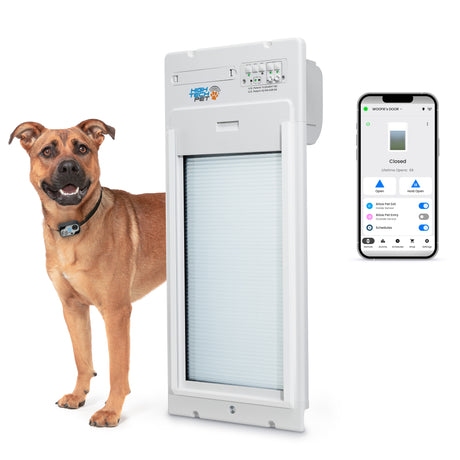


If you've ever caught your dog clawing at a wooden door, smearing nose prints across a glass door, or bolting outside the second a door cracks open, you're dealing with one of the most common — and most fixable — behavior issues pet owners run into. Door etiquette isn't really about obedience for its own sake; it's about safety, home upkeep, and reducing the daily friction of managing a dog who treats every door in the house as something to wait at, paw at, or dash through. The good news is that most door-related bad habits come from the same root cause: dogs don't have an independent way to get where they want to go, so they improvise. Training solves part of that. A properly installed doggie door solves the rest — and for a lot of households, it turns out to be the faster fix.
Why door manners matter more than you'd think
A dog that hasn't learned basic door etiquette isn't just an inconvenience — it's often a household hazard and a home-maintenance problem rolled into one. Scratched paint and gouged wood on interior doors, cloudy nose-print smudges on glass doors, and a dog that bolts through any opening the second it appears are all symptoms of the same underlying issue: your dog hasn't learned that doors open on a predictable, calm routine, not on demand. Left unaddressed, these habits tend to get worse over time rather than better, since a dog that successfully bolts through a door once learns that pushing past you works.
Teaching "wait" before any threshold
The single most useful command for door etiquette is a simple "wait" — not a full sit-stay, just a pause before crossing any threshold. Start with the door closed, ask for a sit, and only open it once your dog is calm. If they surge forward, close the door again and reset. Most dogs pick this up within a couple of weeks of short, consistent repetitions, and it transfers to every door in the house — the front door, the back door, even the car door — once it's a solid habit rather than a one-off trick.
Stopping the scratching habit at wooden and glass doors
Scratching at a door is almost always a request — your dog wants out, wants in, or wants your attention, and scratching is the fastest way they've found to get a response. The fix isn't punishment, it's removing the payoff: stop opening the door in direct response to scratching, and instead reward calm behavior, like sitting or standing quietly, with access instead. This takes consistency from everyone in the household, since a single person "giving in" to the scratching resets the habit. Wooden doors and glass doors show the damage the fastest, which is often what pushes owners to look for a permanent fix.
Curbing the door-darting reflex
A dog that bolts through any open door is a genuine safety risk, especially near a street. This habit usually gets worse the more opportunities a dog has to succeed at it, so the training fix is about controlling access during the learning phase — using a leash indoors near high-traffic doors, and practicing the "wait" command specifically at the exact door your dog tends to dart through. Consistency matters more than intensity here: a few calm, short sessions every day beats one long session once a week.
Reducing barking and pawing at the door
Persistent barking or pawing at a door is frequently a dog communicating an unmet need rather than acting out — they want outside access and don't have another way to ask. Redirecting this takes patience: reward quiet moments near the door generously, and avoid responding to the loudest or most demanding version of the request, since that teaches escalation works. Over time, most dogs shift toward calmer, quieter signals once they learn those get results too.
Where a doggie door removes the need for most of this training
Here's the part worth knowing before you invest weeks of training time: a lot of door-related bad behavior exists because your dog has no independent way to get outside when they need to. Scratching, barking at the door, and pacing near it are frequently just a dog asking for access they don't otherwise have. A properly installed doggie door — sized and set up for your dog, with a secure automatic locking mechanism rather than a simple flap — removes that underlying frustration entirely. Dogs with reliable independent access to the yard tend to stop treating every door in the house as something to negotiate, simply because they're no longer waiting on a person to open it.
Ready to Upgrade?
Training and a doggie door aren't an either-or choice — they solve different parts of the same problem. Basic door manners are still worth teaching for the doors your dog doesn't have independent access through, but for the door they use most, a secure, automatic doggie door does more to stop scratching, barking, and door-darting than weeks of repetition ever will. If you've been working on door etiquette without much progress, it might be less a training problem and more an access problem.