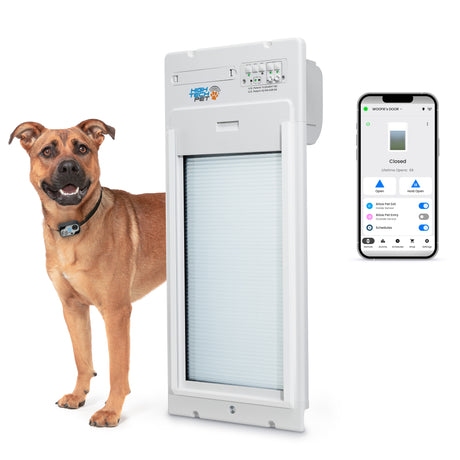


Most people assume a pet door either lets an animal through or it doesn't — there's no in-between. But a smart dog door with directional sensing can tell whether your dog is trying to come inside or go outside, and treat those two situations completely differently. That distinction opens up a lot of control most owners don't realize they have. Once you start thinking about entry and exit as two separate, independently controllable events rather than one single "open or closed" state, a lot of situations that used to require constant supervision — puppy housetraining, recovery from surgery, managing a nervous or newly adopted dog — become much easier to handle without you having to physically stand at the door managing it yourself.
How direction gets detected
The Power Pet door uses paired sensors positioned on the inside and outside of the frame. When your dog approaches, the order in which those sensors are triggered tells the door which direction they're moving. Approaching from outside trips the exterior sensor first; approaching from inside trips the interior sensor first. That sequence is what the door's logic reads as "entering" versus "exiting."
Why directional sensing matters more than you think
Directional sensing is what makes settings like "in only" or "out only" possible in the first place. Without it, a door can only be fully open or fully locked — it has no way to allow one direction of travel while blocking the other. With it, you can let your dog back inside anytime while restricting when they're allowed to head back out, or the reverse, depending on what your household needs.
Everyday situations where directional sensing helps
Keeping a dog inside during a thunderstorm; managing a multi-pet household where one dog needs more restricted yard time than another; making sure a senior dog doesn't wander out unsupervised late at night; directional control turns a one-size-fits-all door into something closer to a house rule you can actually enforce.
What to look for in a directional sensing smart pet door
Response speed matters — a laggy sensor can mean your dog bumps into a door that hasn't caught up yet. Look for models with clear documentation on sensor placement and range, and check that the direction settings are easy to change without a full reset, since most households adjust them seasonally or as a dog's routine changes.
How it interacts with other access settings
Directional sensing typically works underneath whatever access mode you've selected, rather than as a separate setting you manage on its own. Choosing "In Only" or "Out Only" is really just telling the door which direction, as detected by the sensors, should be allowed to trigger unlocking. That means the accuracy of the underlying directional detection directly affects how reliable those access modes feel in daily use — if the sensors are well-calibrated, switching between modes should feel seamless, and if they're not, you may notice occasional missed triggers in one direction. It's worth testing both directions after any settings change to confirm the door is reading them correctly. You can set your Power Pet Door to allow entry only, exit only, bioth, or neither in the Power Pet Door app.
How this differs from a simple locked door
A door that's just locked blocks movement in both directions equally, which doesn't help if your goal is more nuanced than an all-or-nothing block. Directional sensing lets the door stay functionally unlocked while still enforcing a one-way rule, so your dog isn't dealing with a fully sealed opening — they're dealing with a door that's selectively responsive depending on which way they're headed. That distinction matters most in situations where you want partial freedom, not a full lockout.
Related Reading
In Only, Out Only, or Both? The Smart Dog Door Setting Most Owners Don't Know About
How Does an Ultrasonic Dog Door Keep Raccoons and Neighborhood Cats Out?
Ready to Upgrade?
If you've ever wished you could give your dog partial access instead of an all-or-nothing choice, directional sensing is the feature that makes it possible. It's the kind of setting most owners don't know to look for until they're already dealing with a situation it would solve, whether that's a puppy still learning boundaries, a recovering pet, or just wanting more control over when your dog comes and goes. Once you've used a door with directional control, going back to a simple locked-or-unlocked flap tends to feel like a step backward. It's a small feature that quietly changes how much flexibility you have day to day.