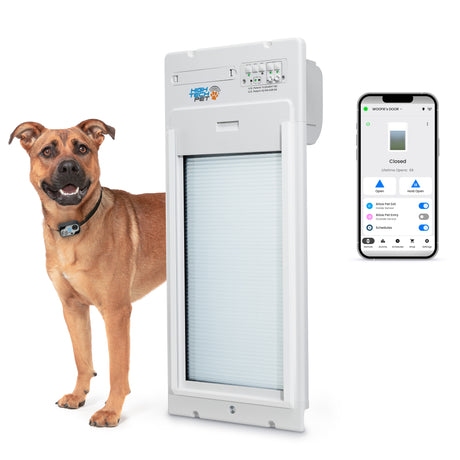


"Automatic dog door" covers a wide range of products, from a door that just senses motion to one that's closer to a small home security system built around your dog. If you're comparing options and the feature lists are starting to blur together, here's a quick rundown of what actually separates a genuinely smart door from one that's automatic in name only.
Selective locking, not just motion sensing
The most important feature isn't flashy — it's whether the door only opens for your dog, or for anything that gets close enough to trigger it. Selective locking, usually via a collar-worn transmitter or embedded microchip, is what keeps raccoons, strays, and neighborhood animals out while your dog moves freely. A door that opens for any nearby motion isn't meaningfully different from an unlocked flap.
Access mode control
Better automatic doors let you restrict direction of travel, not just lock or unlock the whole thing. Common modes include letting your dog in but not out, out but not in, both freely, or fully locked — useful for housetraining, recovery periods, or simply wanting more control overnight without needing to babysit the door yourself.
Scheduling
Rather than manually switching modes throughout the day, scheduling lets you set access windows in advance — open in the morning, locked during the day, open again in the evening — and the door follows that routine automatically, even on days you're not home to manage it.
Remote app control and notifications
Most automatic doors in this category connect to a companion app, letting you lock, unlock, or check the door's status from your phone. Paired with real-time notifications, you get a full picture of your dog's door activity without needing to be home or watching a camera — useful for confirming a pet sitter's visit or just settling the "did I lock it" question after you've left the house.
Safety behaviors you don't think about until you need them
A few features matter specifically for your dog's safety rather than convenience. An anti-lockout safeguard makes sure your dog can always get back inside even during a power outage or system reset. A position-sensing hold keeps the door from closing on a dog who's paused halfway through the frame — not a malfunction, but a deliberate safety response built into well-designed doors.
Security add-ons for larger openings
Bigger dogs need bigger doors, and bigger openings deserve more security scrutiny. Look for a true mechanical deadbolt rather than just a flap latch if the opening is large enough to be a realistic entry point, along with weatherproofing that's rated for more than light drafts if the door is going into an exterior wall in a region with real weather extremes.
Ready to Upgrade?
The feature list on an automatic dog door can look overwhelming, but it breaks down into a few real questions: does it lock selectively, can you control access direction and timing, can you monitor and manage it remotely, does it fail safely, and is it secure enough for the size of the opening. A door that checks those boxes is doing the job an "automatic" door is supposed to do — everything else is a bonus.