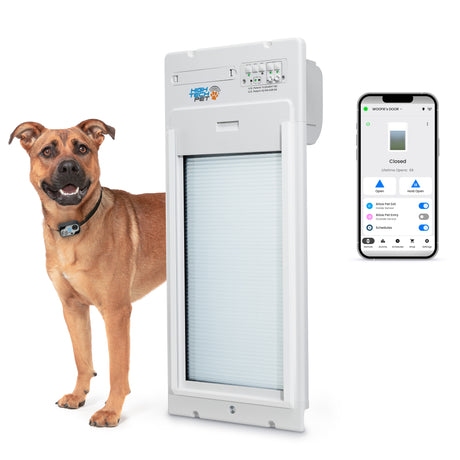


Cats have a way of making their opinions known at the door, and if you're still relying on a manual flap — or worse, playing full-time doorman — it's worth knowing what separates a genuinely smart, electric cat door from a flap with a marketing upgrade. Modern homes have more reasons than ever to make the switch: multi-cat households, mixed dog-and-cat homes, security-conscious owners, and anyone tired of finding a raccoon in the kitchen. Here's what actually matters when you're comparing electric cat doors, not just what the packaging claims.
What actually makes a cat door "electric"
A basic flap door is just a hinge and a curtain — anything can push through it if it's motivated enough. An electric cat door adds a locking mechanism that only releases for an authorized signal, usually from a collar-mounted transmitter or an embedded microchip reader. The distinction matters more than it sounds: a locked, selective door means your cat gets in and out freely while raccoons, opossums, and the neighbor's cat get nothing. If a "smart" cat door doesn't include this kind of selective locking, it's not meaningfully different from a flap.
Collar sensor authentication vs. other methods
Most electric cat doors use one of two authentication methods: a collar-worn transmitter or a built-in microchip reader. Collar sensors tend to have longer range and faster response, which matters for cats who don't love waiting at a door. Microchip readers skip the collar entirely, reading the chip your vet already implanted — appealing if you'd rather not add a collar, though range is typically shorter and your cat needs to get close enough for the door to read the chip. Neither is universally "better" — it comes down to whether your cat tolerates a collar and how quickly you want the door responding.
Sizing and placement — cats aren't small dogs
A lot of electric pet doors are designed dog-first and offer a cat-sized option as an afterthought. That shows up in small but annoying ways: opening height that doesn't match how a cat actually approaches a door (often from an angle, not head-on), or a locking mechanism that's overbuilt and adds unnecessary resistance for a lighter animal. A door genuinely designed for cats accounts for how differently they move through an opening compared to a dog.
Weatherproofing and everyday security
Because cat doors are often installed in a wall, glass door panel, or lower section of an exterior door, weatherproofing matters just as much as it does for dog doors — a poorly sealed cat door is a draft and moisture problem year-round, not just during storms. On the security side, look for a true locking mechanism (not just a magnetic close) if the opening is in an exterior wall, since even a cat-sized hole is still a hole in your home's perimeter.
Multi-cat households and individual settings
If you've got more than one cat — or cats and dogs sharing the same door — look for a model that supports multiple registered collars or chips with independent settings, not just a shared on/off state. This matters most in households where one cat needs restricted access (an indoor-only cat recovering from surgery, for example) while others come and go freely. A door that treats every registered pet identically forces compromises that a profile-based system avoids entirely.
Ready to Upgrade?
The "top" electric cat doors for a modern home aren't defined by price or brand — they're defined by selective locking, reliable authentication, cat-appropriate sizing, real weatherproofing, and support for more than one pet if you need it. A door that checks all five of those boxes is doing the actual job; anything missing one or more is cutting a corner somewhere you'll eventually notice.