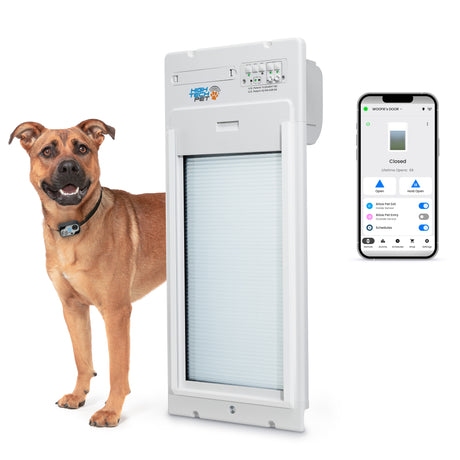


Buy an automatic dog door and it's tempting to set it up once and never open the settings again. That's a shame, because Power Pet comes with four distinct access modes, and the one most owners never touch — restricting direction of travel — solves problems a simple lock/unlock toggle can't. Spending a little time in the settings menu after installation, rather than leaving everything on the factory default, is often the difference between a door that just barely works for your household and one that's actually tuned to how your dog's day-to-day routine works.
The four modes, explained plainly
"Both" is the default most people leave it on: your dog can freely come and go. "In Only" lets your dog back inside anytime but won't let them back out — useful for bad weather or bringing a dog in for the night. "Out Only" is the reverse, letting them outside but not back in unsupervised, which some owners use during specific training windows. "Locked" disables the door completely, for overnight security or when you don't want any pet traffic coming through.
Why four modes beats a simple on/off
A door that only locks or unlocks assumes your dog's access needs are the same at every hour of the day. In practice they're not — nighttime, mealtimes, bad weather, and guests all change what you actually want the door to allow. Four-way control lets the door match your actual routine instead of forcing an all-or-nothing decision every time.
Real scenarios where four-way access pays off
Say you're housetraining a puppy and want them to go in and out on a schedule but not wander back in and track through the house unsupervised — Out Only handles that. Or you've got a dog recovering from surgery who needs restricted outdoor time but should always be able to get back inside — In Only covers it. Multi-pet homes can even set different timers for different pets who need to be in and out at different times of day or night. The Power Pet Door app offers 24/7 scheduling. Whatevery your pets' needs, you're in complete control.
Setting it up without overthinking it
Start with Both for the first week so your dog gets comfortable with the door itself, then introduce In Only or Out Only only once you have a specific reason — most owners find they only need to switch modes a handful of times a month, not daily.
Combining modes with a schedule
Four-way access control becomes even more useful once it's paired with scheduling rather than switched manually every time your routine changes. Instead of remembering to flip the door to Locked every night, you can schedule your dog door to switch automatically, and use the manual mode change only for one-off situations that fall outside your normal routine. This combination — a baseline schedule handling the predictable parts of your day, with manual mode changes reserved for exceptions — tends to be far less effort to maintain long-term than trying to manage every access change by hand, and it means the door keeps doing the right thing even on days you forget to think about it.
How switching modes usually works
Changing between In Only, Out Only, Both, and Locked is as quick as changing the setting in the Power Pet Door app or on the physical control panel, not something that requires a technician visit or hardware change. That's part of what makes four-way access control practical day to day — you're not locked into whatever mode you picked at installation, and adjusting for a specific week or situation is meant to be quick enough to do without much thought.
Related Reading
Can a Dog Door Tell the Difference Between Coming In and Going Out? Yes — Here's How
Two Dogs, Two Very Different Door Settings: How Individual Pet Profiles Work
Ready to Upgrade?
If you've had your automatic dog door set to "Both" since installation and never looked back, it's worth exploring the other three modes — there's a good chance one of them solves a problem you've been working around manually. Most owners default to Both simply because it's the setting the door ships with, not because they've actually considered whether it's the right fit for their household's routine. Spending a few minutes reviewing In Only, Out Only, and Locked against situations you deal with regularly — housetraining, recovery periods, or simply wanting more control overnight — often reveals a mode that fits better than the default ever did.