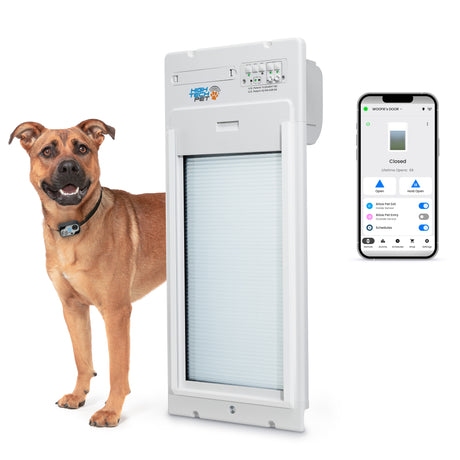


Is your dog too fast for their door? Here's the fix:
Let's sync up your smart pet door to your pet's speed. If your dog runs up to their Power Pet Door and the panel isn't fully rolled up by the time they arrive, the problem isn't your doggie door, and it's not your dog — it's the range setting.
Smart Range Control lets you adjust how far away your dog needs to be when the door starts responding. Set it right, and the door is open and ready before they get there. Set it wrong, and a fast dog wins the race every time.
What the range knobs actually control
Range refers to how far away your dog's collar transmitter needs to be before the door starts to unlock and open. Set it too near, and a fast-moving dog triggers the door too late — they're already at the threshold before the door has had time to respond. Set it too far, and the door may start opening every time a dog walks past it inside the house without any intention of going through.
Smart Range Control gives you a way to dial this in specifically for how your dog moves.
Fast dog? Set a longer range
If your dog charges the door at full speed, a longer range gives the door more lead time. By the time they arrive, the panel has already rolled up. No collision, no hesitation, no waiting at a half-open door.
Slower or older dog? Set a shorter range
A dog that approaches cautiously or moves slowly doesn't need the door opening from across the yard. A shorter range means the door responds when they're actually ready to use it — not before.
A reasonable starting point: shorter range for smaller or more hesitant pets, longer range for larger, faster, or more confident ones. Adjust after a few days of real use — if a pet is triggering the door accidentally, tighten the range; if they're struggling to get it to respond, widen it.
When to revisit your settings
Range settings don't need to be permanent. A growing puppy, a pet that's gained or lost weight, or a new collar can all shift how a previously well-tuned range performs. It's worth checking every few months, or any time you notice missed or false triggers becoming a pattern. Because each profile is independent, adjusting one pet's range doesn't affect anyone else's — so it's usually a quick fix rather than a full reconfiguration.
Test after you set it
Once you've adjusted your range, walk your dog through their approach zone a few times to confirm the door responds at the right moment. Small adjustments are common in the first week as you fine-tune for your yard's layout and your dog's actual approach speed and path.
Related Reading
Two Dogs, Two Very Different Door Settings: How Individual Pet Profiles Work
In Only, Out Only, or Both? The Smart Dog Door Setting Most Owners Don't Know About
Ready to upgrade to a door that keeps up?
If your current pet door can't be tuned to your dog's speed and approach style, it's working against you — not with you. Power Pet's Smart Range Control is one of several reasons pet owners upgrade from basic electronic doors to a door that actually adapts to the way their pets move.
If you're managing a fast dog, multiple pets, or just a door that never quite feels dialed in, it's worth a look.