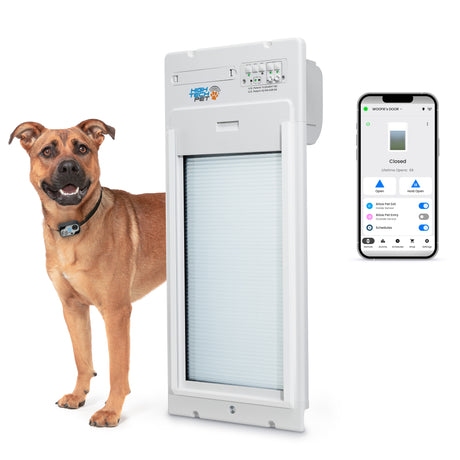


Shopping for an electric cat door usually starts with a long feature list that's hard to prioritize. A more useful way to approach it is as a short sequence of actual decisions — five questions that, answered in order, narrow the field down to the right door for your specific situation instead of the door with the most bullet points.
Decision 1: Collar sensor or microchip reader?
This is the first real fork in the road. A collar sensor gives you longer range and a faster response, but it means your cat wears a small transmitter. A microchip reader skips the collar entirely and reads the chip your vet already implanted, though typically with shorter range and a bit more patience required at the door. If your cat won't tolerate a collar, this decision is basically made for you.
Decision 2: How many pets need access, and do their needs differ?
One cat with simple needs is a different purchase than a household with multiple cats, or cats and a dog sharing space. If more than one animal needs to use the door, check whether the model supports multiple registered collars or chips with independent settings — not just a shared on/off state — especially if one pet needs different access than the others.
Decision 3: Where is it actually going?
An exterior wall installation, a glass door cutout, and an interior door each have different requirements. Exterior walls benefit from a fully insulated, framed tunnel through the wall thickness. Glass installations need a proper sealing kit made for that material specifically. Interior doors have the lightest requirements of the three, since weatherproofing isn't a factor indoors.
Decision 4: How much security does the location actually need?
Not every installation needs the same level of security. A cat door on an interior laundry room door has very different stakes than one cut into an exterior wall in a ground-floor room. For exterior installations, a true locking mechanism matters more than it would indoors, where the bigger risk is usually just the wrong pet getting through, not an outside intrusion.
Decision 5: Do you want manual overrides or extra convenience features?
Some models offer a manual lock-out option for temporarily restricting an otherwise-authorized pet, or a hold-open setting for cleaning or moving things through the opening. These aren't essential, but they're worth deciding on deliberately rather than discovering you wanted one after the fact.
Putting it together
Walk through these five decisions in order — authentication method, number of pets and their needs, installation location, security level, and any extra convenience features — and you'll usually land on two or three realistic options instead of an overwhelming full catalog. That's a faster path to the right door than comparing spec sheets feature by feature.