

Potty training a puppy feels overwhelming mostly because it seems like it should be simple — let them out often enough, and they'll figure it out. In practice, successful potty training is less about the puppy figuring anything out and more about you managing their environment closely enough that accidents rarely get the chance to happen in the first place. Get the management right, and the training follows.
It's about management, not punishment
The biggest mindset shift that speeds up potty training is realizing it's primarily a supervision problem, not a discipline problem. Punishing an accident after the fact teaches a puppy to fear you, not to associate the yard with bathroom breaks — dogs don't connect a scolding minutes later with something they did earlier. The far more effective approach is preventing accidents through close supervision and a consistent schedule, so the puppy is reliably successful outside and rarely has the opportunity to go wrong indoors.
Setting a schedule that actually works
Puppies need bathroom breaks far more often than adult dogs — generally after waking up, after eating or drinking, after playtime, and before bed, at minimum. A reasonable starting rule of thumb is roughly one hour of bladder control per month of age, so an 8-week-old puppy needs an opportunity to go out about every two hours during the day. Taking your puppy to the same spot each time also helps, since the scent cues reinforce where "the bathroom" actually is.
Using a crate as a tool, not a punishment
A properly sized crate — just big enough to stand, turn around, and lie down in, not larger — leans on a puppy's natural instinct not to soil the space they sleep in. This isn't about confinement for its own sake; it's a management tool that limits opportunities for accidents when you can't supervise directly, and most puppies adjust well to a crate introduced gradually and paired with something positive, like a meal or a chew toy.
Learning to read the signals before an accident
Puppies usually signal before they go — circling, sniffing the ground intently, sudden restlessness, or heading toward a door. Catching these cues early and getting your puppy outside within that window is what turns "trained" from a hopeful guess into something you can actually predict. Keeping a puppy in the same room as you (rather than out of sight in another part of the house) makes it far easier to catch these signals in the first few months.
How long potty training actually takes
Most puppies reach basic reliability somewhere between four and six months of consistent training, though this varies more than people expect. Smaller breeds tend to take longer due to smaller bladders and faster metabolisms, and any puppy can take up to a year to be fully, consistently reliable, including overnight. A slow week or an occasional regression, especially around a routine change, doesn't mean training has failed — it's a normal part of the process, not a sign to start over.
Where a doggie door fits in — once training is established
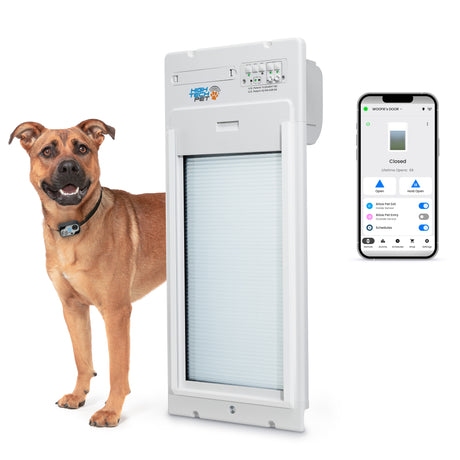
An automatic doggie door isn't a substitute for the training itself, and introducing one too early, before a puppy has learned to reliably signal and hold it, can actually work against the habits you're building. Once your puppy has a consistent routine and is physically large and coordinated enough to use a door safely, though, a doggie door can help maintain that routine by giving them the same reliable, on-demand access that reinforced their training in the first place — rather than a return to unsupervised free access before they're ready for it.
Ready to Upgrade?
Potty training success comes down to a consistent schedule, close supervision, and reading your puppy's signals before an accident happens — not punishment after the fact. Expect the process to take several months, and treat setbacks as normal rather than a sign something's wrong. Once your puppy's routine is solid, that's the right time to think about giving them more independent access, not before.