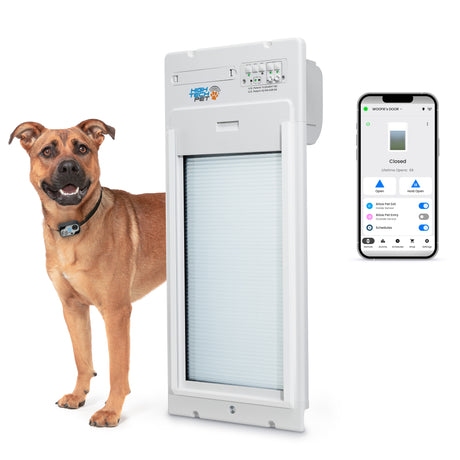


A garage is a functional, often hazard-filled space in a way most other pet door locations aren't — moving vehicles, stored chemicals, tools, and a door mechanism with real mechanical force behind it. If your dog has independent access to a garage through a doggy door, a few safety checks are worth doing beyond the standard installation.
Why garages carry extra safety considerations
Unlike a backyard-facing wall or door, a garage combines a pet door with an environment that has its own set of hazards — sharp tools, chemicals, vehicles, and a large mechanical door. Treating this installation as purely a construction project misses the ongoing safety questions that come with what's actually inside the space your dog now has access to.
Keep the opening clear of the garage door's hardware
Beyond just avoiding panel seams during installation, periodically check that nothing has shifted near the pet door opening — springs, cables, and tracks carry real mechanical tension, and a pet door positioned too close to that hardware is worth reassessing even after installation is complete, not just during the initial planning.
Think about vehicle safety, not just the opening
If your dog has independent garage access, consider where they'll actually be moving once inside — is there a clear, safe path away from where vehicles are parked or pull in? A pet door that puts your dog directly in a vehicle's path when backing in or out is a real risk worth designing around, not an afterthought.
Keep hazardous materials genuinely out of reach
Garages commonly store antifreeze, cleaning chemicals, fertilizer, and tools, several of which are dangerous if a pet gets into them. If your dog has unsupervised garage access via a doggy door, make sure anything hazardous is stored on a shelf or in a cabinet actually out of reach, not just set aside on the floor.
Watch for temperature extremes
An uninsulated or poorly ventilated garage can reach dangerous temperatures in both directions — hot enough to risk heatstroke in summer, cold enough to be a genuine concern in a harsh winter. If your dog has extended unsupervised access via a garage doggy door, this is worth monitoring seasonally rather than assuming the space is automatically safe year-round.
Confirm the fail-safe features work here too
If your door has an anti-lockout feature guaranteeing entry during a power outage, confirm it actually functions as expected in your specific garage setup, especially if the garage door opener and the pet door share electrical circuits. A safety feature that works everywhere else in the house is worth a specific test in this environment before you rely on it.
Ready to Upgrade?
A garage doggy door is convenient, but it comes with safety considerations beyond a standard exterior installation: keeping the opening clear of moving hardware, accounting for vehicle paths, securing hazardous materials, watching temperature extremes, and confirming fail-safes work in this specific space. A few checks now prevent a much bigger problem later.