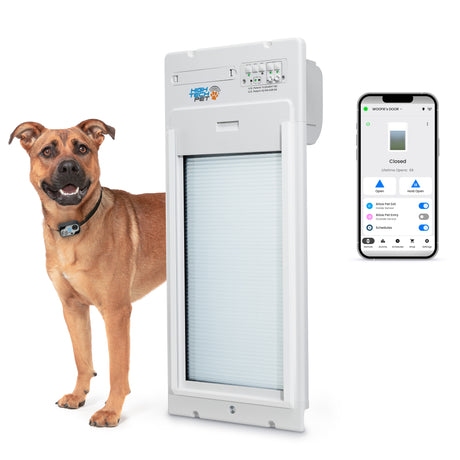


Not every dog needs unrestricted outdoor access around the clock, and not every owner wants to manually manage a door twice a day to enforce that. 24/7 entry and exit scheduling on an automatic pet door lets you set specific access windows in advance, so the door follows your routine even on days you're not home to manage it in real time. It's especially useful for households with an inconsistent schedule week to week, since you're not stuck choosing between a fixed manual routine and giving up structure entirely — the door just follows whatever schedule you've set until you decide to change it.
What scheduling actually sets
Rather than a single always-on or always-off state, scheduling lets you define recurring windows — for example, open access from 7am to 9am, locked during the day while you're at work, and open again from 5pm to 9pm in the evening. The Power Pet system allows different schedules for different days of the week, which matters if your routine changes day-to-day. Shift workers - this is for you!
Why timing control matters for some dogs
Dogs that bark at every passerby benefit from being kept inside during peak daytime foot traffic. Dogs in homes near roads or shared yard space benefit from restricted access outside of supervised hours. And for dogs still building confidence with an automatic pet door, a predictable schedule during the training period can reduce hesitation compared to a door that's unpredictably open or locked.
Setting a schedule that actually matches your day
Start by mapping your dog's current routine — when they typically go out, how long they stay out, and when they come back in on their own — rather than guessing at ideal times. Build the schedule around that baseline first, then adjust after a week of real use rather than trying to get it perfect on day one.
What happens outside scheduled hours
During locked windows, the door behaves the same as if you'd locked it manually — your dog can't pass through until the next scheduled window opens, or until you unlock it manually or remotely. It's worth confirming your specific model's behavior during power outages or Wi-Fi drops. Power Pet Door systems retain their programmed schedule locally even without an internet connection.
Adjusting the schedule as seasons change
A schedule that makes sense in the summer, with long daylight hours and mild evening temperatures, often doesn't hold up as well once it's dark by 5pm or the weather turns. It's worth treating your schedule as something you revisit seasonally rather than a one-time setup, shifting windows earlier or later, or shortening outdoor access during extreme heat or cold. Most apps make this a quick edit rather than a full reconfiguration, so there's little reason to leave a summer schedule running unchanged straight through winter.
Building in exceptions without breaking the schedule
Power Pet's schedulign system lets you manually override a locked window when something unexpected comes up, like a sitter running late or yourself running late getting home from work. The override is temporary, meaning the door returns to its normal scheduled behavior at the next window rather than requiring you to remember to re-lock it — which keeps the schedule reliable even when your day doesn't go exactly as planned.
Related Reading
Can You Control a Dog Door From Your Phone? Here's How Smart Pet Doors Work
What Your Dog's Outdoor Habits Can Tell You — And How to Track Them Automatically
Ready to Upgrade?
If your dog's outdoor access needs to follow a routine rather than be constantly available, a scheduled automatic pet door does that enforcement for you, whether you're home or not. Trying to manually enforce a schedule — physically locking and unlocking a door at set times every day — is the kind of task that works fine for a week and then quietly falls apart the first time your day runs long. Automating it removes that failure point entirely, so the schedule holds even on the days you're too busy to think about it. Set it up once and it just keeps running, exactly as intended, without needing your attention again.