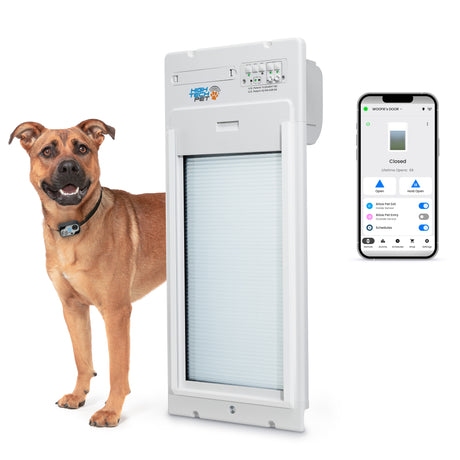


An extra large dog door isn't just a large dog door scaled up a few inches — giant breeds come with their own sizing, structural, and usability considerations that a standard "large" category doesn't fully address. If you've got a Great Dane, Mastiff, Saint Bernard, or another giant breed, here's what actually changes at this size.
What counts as "extra large," and who needs it
Most manufacturers separate "large" from "extra large" somewhere around 90-100+ pounds or a shoulder height above roughly 26-28 inches, though thresholds vary by brand. Giant breeds — Great Danes, Mastiffs, Saint Bernards, Newfoundlands — are the primary audience here, and the difference matters because a door sized for a 70-pound Labrador often isn't tall or wide enough for a dog built at genuinely giant-breed scale.
Measuring correctly for a giant breed
The most common sizing mistake at this scale is measuring shoulder height alone and ignoring chest width, which tends to be proportionally larger on giant breeds than on medium dogs. Measure your dog's chest width at its widest point in addition to standing height, and check that measurement against the manufacturer's opening dimensions specifically — not just the weight range, which can vary a lot between breeds of similar size.
Structural considerations scale up too
A cutout large enough for a giant breed removes significantly more material from a wall or door than a standard or large-size opening, which means the surrounding structure needs more reinforcement to stay sound. This is less of a DIY-friendly project at extra-large scale than it is at smaller sizes, and it's worth budgeting for professional installation specifically because of the amount of material being removed and the framing needed to support it.
Security still matters, and scales with the opening
An extra-large opening is, by definition, large enough for an adult person to fit through, which means the security considerations that apply to any large dog door apply even more directly here. A true deadbolt locking mechanism rather than a flap latch is worth prioritizing at this size, especially for ground-floor or street-facing installations.
Flap weight and ease of use
A heavier-duty flap built to withstand a giant breed's size can actually be harder for some dogs to push through, particularly senior dogs or breeds prone to joint issues, which is common among several giant breeds. Look for a model that balances durability with a reasonably light push-through resistance, and consider power-assisted or fully automatic opening if your dog is older or has known mobility concerns.
Cost and installation expectations
Extra-large dog doors tend to cost more than standard sizes, both in the unit itself and in installation, given the additional structural work involved. It's worth budgeting for this upfront rather than being surprised by it, and getting an installation quote before committing to a specific model, since labor costs can vary significantly based on your wall or door material.
Ready to Upgrade?
Choosing the right extra-large dog door comes down to measuring your specific dog accurately — chest width, not just height — planning for real structural reinforcement, prioritizing genuine security given the opening size, and considering flap resistance if your dog is older or prone to joint issues. Get those right, and an extra-large door works just as reliably as any smaller one.