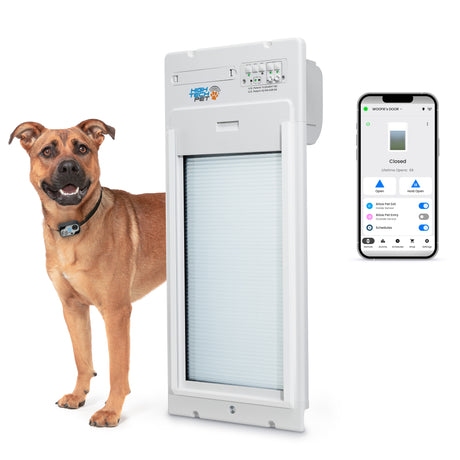


Getting the size right is one of the most important — and most commonly gotten wrong — decisions when choosing a doggie door. Too small, and your dog struggles to fit through comfortably. Too large, and you compromise security and energy efficiency for no benefit.
Measure your dog correctly
Start by measuring your dog's shoulder height (the tallest point of the back, not the head) and width at the widest point, usually the chest or hips. A pet door should be sized to these measurements with some margin, not guessed based on breed alone, since size varies significantly even within a breed.
Size up if you have multiple pets
If more than one pet will use the same door, size for your largest pet, not your smallest. A doggie door sized only for a smaller pet in the household will force a larger pet to squeeze through, which isn't safe or comfortable long-term.
Don't oversize "just in case"
It might seem safer to size up for a growing puppy or a "just in case" scenario, but an oversized pet door creates unnecessary drafts, reduces security, and can make a smaller dog hesitant to use it. Size for your dog's current or near-final size, and consider resizing later if needed rather than overbuying now.
Check the height of the opening off the ground
Beyond width and height of the flap itself, consider how high off the ground the opening sits. The best dog door for door installations accounts for your dog's leg length and ability to step through comfortably, not just squeeze through.
Consider glass doors and sliders separately
Sizing for a glass door dog installation, such as a sliding glass door insert, often works differently than a standard exterior door cutout, since the insert has to fit within the track dimensions of the slider itself. Measure the specific glass door opening before assuming a standard size will work.
When in doubt, size up slightly rather than down
If your dog is between sizes, most manufacturers recommend sizing up slightly rather than down, since a dog can adjust to a marginally larger opening more easily than squeezing through one that's too tight.
Ready to Upgrade?
Getting the size right from the start saves you from a frustrating resize or replacement later. Measure carefully, size for your largest pet if there's more than one, and don't oversize just to be safe.