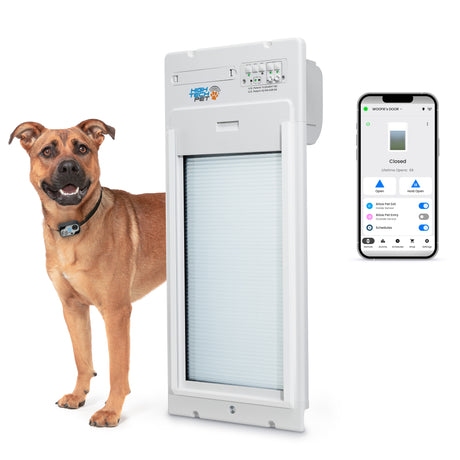


Apartment living adds a layer of constraints that most pet door advice doesn't account for — you probably can't cut into a wall, your lease may restrict permanent modifications, and whatever you install needs to either come out cleanly when you move or be something you're willing to leave behind. Here's how to think about a cat door when renting changes the rules.
Why apartments change the equation
Most standard pet door installation advice assumes you own the property and can modify it freely. Renters are usually working within real restrictions — no cutting into walls or doors, needing landlord approval for anything permanent, and wanting a setup that doesn't jeopardize a security deposit. That rules out a lot of the "just cut an opening" advice that applies to homeowners.
No-cut installation options
Window and sliding glass door insert panels are the best fit for most apartments, since they fit within an existing track or window frame without modifying the glass, wall, or door itself. These installations are designed to be removed and the original window or slider restored, which is exactly the kind of reversibility a lease situation calls for.
Interior cat doors for small-space problems
In a smaller apartment, the usual indoor cat door benefits — keeping a roommate's dog out of the litter box, separating cat food from other pets — become even more relevant, simply because there's less physical distance to work with. An interior cat door on a bedroom or bathroom door (which typically doesn't require the same landlord approval as an exterior modification) can solve a lot of small-space friction without touching anything structural.
Portability matters more here
Since renters move more often than homeowners, it's worth choosing a cat door designed to be removed and reinstalled cleanly rather than one that's effectively permanent once in place. Window and slider inserts have a real advantage here — they typically pack up and move with you, and the original window or door goes back to its unmodified state.
Noise and thin walls
Apartment walls and doors tend to be thinner than a single-family home's, which means a cat door with a loud flap or an audibly clicking lock mechanism is more likely to be noticeable to you — and potentially neighbors — than it would be in a house. If noise is a concern, look specifically for a quiet-operating mechanism and a well-cushioned flap edge rather than assuming any electronic door is equally quiet.
Getting it approved
Even reversible installations are worth clearing with your landlord or lease terms before you install anything, since "no permanent modification" is sometimes interpreted more strictly than you'd expect. A quick photo or spec sheet showing the insert is removable without damage is often enough to get sign-off, and it's a much easier conversation to have before installation than after a move-out inspection.
Ready to Upgrade?
The best cat door for apartment living isn't necessarily the most feature-packed one — it's the one that installs without permanent modification, comes with you when you move, and doesn't create a lease problem along the way. Window and sliding glass inserts check all three boxes better than almost any other installation type.