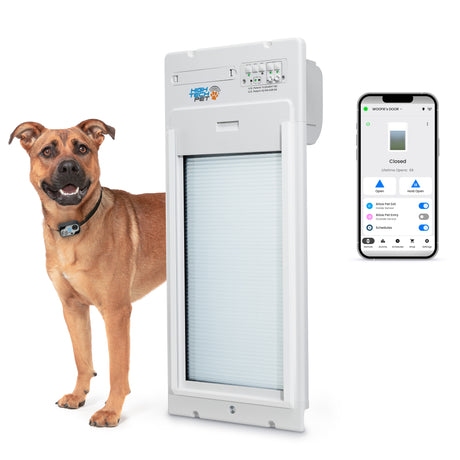


A garage door isn't built like a standard exterior door, and installing a doggy door into one takes a different set of precautions than cutting into a solid wood or fiberglass door. Sectional panels, springs, tracks, and thin metal construction all change what "installing it properly" actually means here.
Why garage doors need special handling
Most garage doors are made up of several hinged panels that bend at the seams as the door rolls up and down its track. Cutting into the wrong spot — too close to a panel seam, a hinge, or the track itself — can interfere with how the door operates or weaken a section in a way that shows up later as a structural or safety issue. This is the biggest way a garage doggy door installation differs from any other.
Choosing the right panel and location
Pick a panel away from the door's horizontal seams, hinges, and the vertical tracks on either side, and stay within the central area of a single panel section rather than spanning two. Lower panels are usually the more practical choice both for your dog's height and for keeping the cutout away from the springs and cables located toward the top of the door.
Reinforcing thin steel or aluminum panels
Garage door panels are typically thinner than a standard exterior door, especially steel roll-up doors, which means the cutout usually needs a reinforced frame insert to restore structural rigidity around the opening. Skipping this step can leave the panel flexing or rattling around the cutout, which gets worse over time with repeated door cycles.
Don't throw off the door's balance
Garage doors are counterbalanced by springs calibrated to the door's weight, and removing material for a cutout changes that weight, even if only slightly. For most doggy door sizes this isn't a major issue, but it's worth having whoever installs it check the door's balance afterward — a door that's noticeably harder to lift by hand, or that doesn't stay in place when partially open, may need a spring adjustment.
Weatherproofing an often-uninsulated space
Garages are frequently less insulated than the rest of the house, and a garage door itself is often the least insulated surface in the space. A well-sealed, insulated doggy door insert matters here just as much as it would on an exterior wall — otherwise you're adding a fresh air leak to a space that may already run colder or hotter than the rest of your home.
Setting up the full path, not just the garage door
For most households, a garage doggy door is one link in a longer route — dog goes from the house into the garage through an interior door, then out through the garage doggy door to the yard. If that's your setup, make sure the interior door between the house and garage is also something your dog can access reliably, whether that's a second pet door or simply a door left accessible, since the garage installation alone doesn't complete the path.
Ready to Upgrade?
Installing a doggy door in a garage door takes more planning than a standard wall or door installation: avoid the panel seams and hardware, reinforce the thin metal around the cutout, check the door's balance afterward, and don't skip insulation just because it's "only the garage." Get those right and it works as smoothly as any other installation.