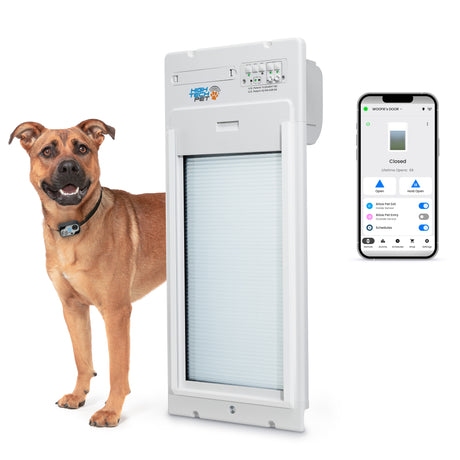


Automatic dog door listings tend to bury the important decisions under a long list of features that all sound equally important. A more useful way to shop is to work through five actual decisions in order — each one narrows the field, so by the end you're comparing a handful of realistic options instead of an entire catalog.
Decision 1: How much security do you actually need?
Start here, since it affects almost everything else. If wildlife, strays, or neighborhood animals are a real concern where you live, prioritize genuine selective locking — collar or chip-based authentication — over a door that's automatic in name but opens for any nearby motion. If security isn't a major concern, this decision matters less and you can weight other features more heavily.
Decision 2: How much access control do you need?
Some households are fine with a simple locked-or-unlocked state; others benefit significantly from four-way access modes (in only, out only, both, locked) and scheduling. Think about your actual routine — housetraining, a multi-pet household, or a dog that needs restricted hours — rather than assuming you'll want every mode available just because it's offered.
Decision 3: Do you need remote control and notifications?
If you're often away from home, work irregular hours, or use a pet sitter regularly, app-based remote control and real-time notifications solve real problems. If you're usually home and don't need that visibility, this feature set adds cost without adding much practical value for your specific situation.
Decision 4: What size is your dog, and does that change your security needs?
A small or medium dog door rarely raises major security concerns beyond basic selective locking. A large or extra-large opening is a different calculation — at that size, prioritize a true deadbolt mechanism and reinforced panel material, since the opening itself becomes a more realistic entry point.
Decision 5: What does your climate demand?
If you're in a region with genuine seasonal extremes, insulation and sealing quality deserve real weight in your decision, not just a checkbox. In a mild climate, this matters less, and you can prioritize other features without much tradeoff.
Putting it together
Walk through these five in order — security needs, access control, remote features, size and security scale, and climate — and most buyers land on two or three realistic options rather than facing the full range of what's available. That's a faster, more confident path than comparing spec sheets side by side.
Ready to Upgrade?
The right automatic dog door isn't the one with the longest feature list — it's the one that matches your actual security needs, routine, size requirements, and climate. Work through the decisions in order, and the right model becomes obvious faster than you'd expect.